
By: Esteban Vélez.
In previous articles (Part 1 and Part 2), we looked at the first four juggling lessons that the juggler Rasso published in various United States newspapers between 1921 and 1922—lessons that appeared on a weekly basis.
This material was discovered following an extensive search for historical records—specifically, archives of United States newspapers from the second decade of the 20th century.
These materials are significant for understanding and analyzing the methods used by certain jugglers of the last century to teach the craft, as well as how juggling knowledge was passed on.
Rasso was a successful juggler born in France. His father was a juggler and a member of the group “Rasso Trio,” while his mother was an opera singer.
Inspired by his father, Rasso developed an interest in juggling, eventually touring throughout the United States, Germany, France, and other countries.
Below, we present parts five and six of Rasso’s series of juggling lessons.
Easy Juggling – Lesson 5
This lesson was published in the Long Beach Telegram newspaper on December 20, 1921.
Juggling long objects
Around one end of a piece of broom- stick two feet long, wrap a strip of lead sheeting two inches wide and six inches in length. Or instead of lead a longer strip of tin may be used. Wrap the metal tightly, and to help hold it in place and to serve as a protection for your hands, wrap it with tire tape. This metal weighs one end of the stick.
Grip the light end with your right hand. If you are left-handed, with your left band. Hold the stick out with your elbow well bent and placed naturally and net stiffly against your body. (Figure 1).
Make half turn
With a sharp flip of the wrist, toss the stick into the air so that the weighted end comes towards you. Use only enough force to make the stick take a half turn. Catch the weighted end.
Repeat the toss a number of times, with both hands to accustom yourself with the amount of force necessary to give the stick a half turn.
Then try the full turn. The stick is tossed in the same manner, except that it has more force behind it and goes higher into the air so that it may make a full turn before being caught. Catch the light end of the stick. You will observe that the stick revolves around the weighted end.
Double and triple turns
It is possible to toss the stick so that it takes a full turn and half, or two full turns, and more. Practice these turns. Always bear in mind that for each additional turn the stick must be tossed with more force and must go higher into the air. Always supply the force from the wrist, and not the whole forearm.
The next step consists of tossing the stick from one hand to the other in an arc, making it take a full or double turn in the air. This is easily done. Try it with a long pencil. (Figure 2).
Prepare another stick. This done, you are ready for a fancy trick-the crossing of two sticks from hand to band.
Crossing two sticks
Hold a stick in each hand Toss the right hand stick up first, making it take a turn toward the left. When it is in mid-air, toss up the left-hand stick, making it take the same number of turns toward the right. It must cross the course of the first stick underneath. (Figure 3 shows the courses of the two).
Do this once and then stop. Do it again and stop. Finally, try to cross the sticks without hesitation. Use a good wrist movement so that you do not appear to be exerting yourself greatly. Toss the sticks evenly. Your audience will be pleased. This form of juggling is excellent for developing the wrist and forearm muscles.
Pop bottles. Indian clubs, and even knives and forks may be juggled in the same manner (Figure 3 shows a boy juggling a knife and forks. I caution you to use a dull knife and to place a large cork over the point. Put a cork on the prongs of the fork).
Next week I shall describe some interesting tricks in balancing which you can do with little or no practice.

Easy Juggling – Lesson 6
This lesson was published in the Long Beach Telegram newspaper on December 27, 1921.
Tricks in balancing
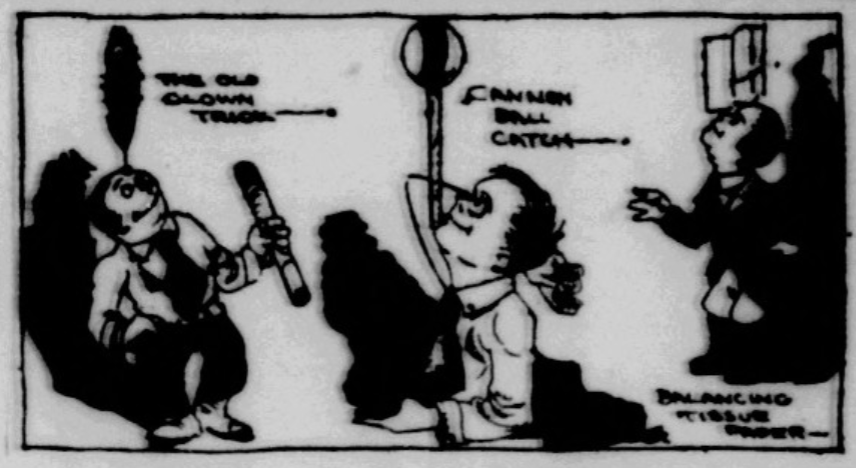
Years ago, circus clowns had a feather balancing trick they often used to amuse their audiences. It is an easy one to do.
Obtain a mailing tube about two feet long. Or. If you wish, you may make a tube of heavy paper. Is should be about an inch in diameter,
Also, obtain a feather about a foot long. A peacock feather is just the thing. Place a bit of putty on the quill end. Pat the feather into the tube. Then, with a deep breath, blow the feather, quill end first, high into the air. The weight of the putty will cause the quill end to come down first. It is a simple matter to catch the feather on your forehead and balance it there. The putty will keep it from slipping off.
Balancing tissue paper
There is a tissue paper balancing trick that I use on the stage to secure a moment’s rest.
Fold a piece of tissue paper about seven inches long and four inches wide, down the center of its length. Then fold it evenly again. Open it out and you will see that it has three creases. Grasp opposite corners and pull on them. This makes the tissue paper a bit stiff.
Bend your head far back. Grasping the tissue paper with both hands. Carefully rest one of the short sides on the tip of your nose and your forehead. When the paper is standing straight, let go of it. Keep It balanced by moving slightly in the direction in which it leans. There should be no draught in the room.
Still another trick is the old cannon ball catch. The juggler balances a heavy cannon ball on the end of a rod on his forehead. Suddenly he knocks the rod from under the ball. As the ball falls, the juggler ducks his head and catches the ball between his shoulders.
You may duplicate the trick in your home, but instead of catching the ball between your shoulders you catch it in your hands, and instead of a cannon ball you use a large, hollow play ball such as may be purchased for a small sum at a variety store.
Use mailing tube again
The mailing tube used in the feather thick will do as rod on which to balance the ball. Place the ball on one end of the tube. Then lift the tube carefully to your chin. If you wish, you may place it on your forehead, but it is easier for your eyes to focus on the ball when the tube is on your chin.
Suddenly, with a sharp move of the band, slap the tube from under the ball. Catch the ball in your hands.
If you pretend that the ball is very heavy and it takes a great deal of effort to balance it on the tube, and that to catch the ball requires the strength of Hercules, the trick will be more amusing to your audience.
Next week we shall take up another phase of juggling-plate spinning.
Easy juggling – las diez lecciones de Rasso – parte 3
Por: Esteban Vélez.
En los artículos pasados (parte 1 y parte 2) vimos las cuatro primeras lecciones de malabarismo que el malabarista Rasso publicó en varios periódicos de Estados Unidos entre 1921 y 1922, las cuales, se publicaban cada semana.
Este material fue hallado luego de una extensa búsqueda de materiales histórico: archivos de diarios de Estados Unidos de la segunda década del siglo XX.
Este material es importante para comprender y analizar cómo era el método usado por algunos malabaristas del siglo pasado para enseñar malabares, y cómo era la transmisión de saberes del malabarismo.
Rasso fue un malabarista exitoso nacido en Francia. Su padre fue malabarista integrante del grupo “Rasso trío”. Su madre fue una cantante de ópera.
Inspirado por su padre, Rasso se interesó por el malabarismo logrando giras por Estados Unidos, Alemania, Francia y otros países.
A continuación, las partes cinco y seis de la saga de las lecciones de malabarismo de Rasso.
Easy Juggling – lección 5
Esta lección fue publicada en el diario Long Beach Telegram, el 20 de diciembre de 1921.
Malabares con objetos largos
Envuelve un extremo de un trozo de palo de escoba de unos 60 centímetros (dos pies) de largo con una tira de lámina de plomo de unos 5 centímetros (dos pulgadas) de ancho y 15 centímetros (seis pulgadas) de largo. También puedes usar una tira más larga de hojalata en lugar de plomo. Enrolla el metal firmemente y, para ayudar a mantenerlo en su lugar y proteger tus manos, cúbrelo con cinta adhesiva (como la que se usa para neumáticos o reparaciones). Este metal añade peso a uno de los extremos del palo.
Sujeta el extremo ligero con la mano derecha (o con la izquierda, si eres zurdo). Mantén el palo extendido con el codo bien flexionado y colocado de forma natural —sin rigidez— junto a tu cuerpo (Figura 1).
Realiza medio giro
Con un movimiento rápido y seco de la muñeca, lanza el palo al aire de modo que el extremo con peso se dirija hacia ti. Aplica solo la fuerza necesaria para que el palo dé medio giro. Atrapa el extremo con peso.
Repite el lanzamiento varias veces, usando ambas manos, para familiarizarte con la fuerza necesaria para lograr medio giro.
Luego, intenta realizar un giro completo. El lanzamiento se efectúa de la misma manera, pero aplicando más fuerza para que el palo suba más alto y pueda completar una vuelta entera antes de ser atrapado. Atrapa el extremo ligero del palo. Observarás que el palo gira alrededor del extremo que tiene el peso.
Giros dobles y triples
Es posible lanzar el palo de modo que realice una vuelta y media, dos vueltas completas o incluso más; practica estos giros. Ten siempre presente que, por cada vuelta adicional, el palo debe lanzarse con más fuerza y alcanzar una mayor altura. Aplica la fuerza siempre desde la muñeca, no con todo el antebrazo.
El siguiente paso consiste en lanzar el palo de una mano a la otra describiendo un arco, haciendo que realice una vuelta completa o doble en el aire. Es sencillo; puedes probar primero con un lápiz largo (Figura 2).
Prepara otro palo. Una vez hecho esto, estarás listo para un truco más elaborado: el cruce de dos palos pasando de una mano a la otra.
Cómo cruzar dos varas
Sostén una vara en cada mano. Lanza primero la vara que tienes en la mano derecha hacia arriba, haciéndola girar hacia la izquierda. Cuando esté en el aire, lanza la vara que tienes en la mano izquierda, haciéndola girar la misma cantidad de veces hacia la derecha. Esta debe pasar por debajo de la trayectoria de la primera vara. (La figura 3 muestra las trayectorias de ambas).
Realiza este movimiento una vez y detente. Repítelo y vuelve a detenerte; finalmente, intenta cruzar las varas sin dudar. Utiliza un buen movimiento de muñeca para que no parezca que te estás esforzando demasiado. Lanza las varas de manera uniforme. Tu público quedará encantado. Esta forma de malabarismo es excelente para desarrollar los músculos de la muñeca y el antebrazo.
Se pueden hacer malabares de la misma manera con botellas, mazas de malabarismo (o «mazas indias»), e incluso con cuchillos y tenedores. (La figura 3 muestra a un chico haciendo malabares con un cuchillo y tenedores). Te advierto que debes usar un cuchillo sin filo y colocar un corcho grande sobre la punta; asimismo, coloca un corcho sobre las púas del tenedor.
La próxima semana describiré algunos trucos interesantes de equilibrio que podrás realizar con poca o ninguna práctica.
Easy juggling – lección 6
Esta lección fue publicada en el diario Long Beach Telegram, el 27 de diciembre de 1921.
Trucos de equilibrio
Hace años, los payasos de circo realizaban un truco de equilibrio con una pluma que solían usar para entretener al público. Es muy sencillo de ejecutar.
Consigue un tubo de cartón (como los que se usan para enviar pósteres) de unos 60 centímetros (dos pies) de largo. Si lo prefieres, puedes fabricar uno con papel grueso. Debe tener un diámetro de unos 2,5 centímetros (una pulgada).
Consigue también una pluma de unos 30 centímetros (un pie) de largo; una pluma de pavo real es ideal. Coloca un poco de masilla en el extremo del cañón (la base de la pluma) e introdúcela en el tubo. Luego, toma aire profundamente y sopla la pluma —con el extremo del cañón por delante— hacia lo alto. El peso de la masilla hará que el extremo del cañón descienda primero. Resulta muy fácil atrapar la pluma sobre la frente y mantenerla en equilibrio; la masilla evitará que se deslice.
Equilibrio con papel de seda
Existe un truco de equilibrio con papel de seda que utilizo en el escenario cuando necesito un breve respiro.
Dobla un trozo de papel de seda —de unos 18 centímetros (siete pulgadas) de largo por 10 centímetros (cuatro pulgadas) de ancho— por la mitad, a lo largo. Después, vuelve a doblarlo de manera uniforme. Al desplegarlo, verás que han quedado tres pliegues. Sujeta dos esquinas opuestas y tira de ellas; esto le dará cierta rigidez al papel.
Inclina la cabeza bien hacia atrás. Sujeta el papel de seda con ambas manos y apoya con cuidado uno de sus lados cortos sobre la punta de la nariz y la frente. Una vez que el papel se mantenga erguido, suéltalo. Mantén el equilibrio moviéndote ligeramente en la dirección hacia la que se incline el papel. Es importante que no haya corrientes de aire en la habitación.
Otro truco más es el clásico «atrape de la bala de cañón». El malabarista equilibra una pesada bala de cañón sobre el extremo de una vara apoyada en su frente. De repente, retira la vara de debajo de la bala con un golpe seco. Mientras la bala cae, el malabarista agacha la cabeza y la atrapa entre sus hombros.
Puedes replicar este truco en casa; sin embargo, en lugar de atrapar la bala entre los hombros, hazlo con las manos. Además, en vez de una bala de cañón, utiliza una pelota grande y hueca, de esas que se pueden comprar por poco dinero en cualquier tienda de artículos variados.
Usa de nuevo el tubo de cartón
El tubo de cartón —el mismo que se empleó en el truco de la pluma— servirá como vara para equilibrar la pelota. Coloca la pelota en uno de los extremos del tubo y, con cuidado, llévalo hasta tu barbilla. Si lo prefieres, puedes apoyarlo en la frente, aunque resulta más sencillo enfocar la vista en la pelota cuando el tubo está sobre la barbilla.
De pronto, con un movimiento rápido de la mano, golpea el tubo para retirarlo de debajo de la pelota y atrápala con las manos.
Si finges que la pelota es extremadamente pesada —tanto que mantener el equilibrio sobre el tubo requiere un gran esfuerzo— y que atraparla exige la fuerza de un Hércules, el truco resultará mucho más divertido para tu público.
La próxima semana abordaremos otra faceta de los malabares: el giro de platos.
Esteban Velez

Soy un malabarista deportivo. Tengo la maravillosa oportunidad de escribir para eJuggle. Me gusta la historia, la historia militar, la filosofía, la poesía, las historias raras, y las historias de terror y de horror.