
By Esteban Vélez.
Rasso was a highly popular juggler in the United States and Europe. He toured extensively, performing in cities across the United States, Italy, France, and Germany, among other countries.
He was born into a family of artists: his father was a renowned juggler and member of the “Rasso Trio,” while his mother was an opera singer. Inspired by his father, he learned to juggle various objects.
In a 1922 interview with The Herald newspaper, Rasso shared details about his life:
“I was born in Alsace-Lorraine—specifically, in Strasbourg. Years later, my mother—a well-known opera singer—took me to Italy to study singing under the celebrated maestro Ugulini. Until the age of nine, I attended the English convent school, where I learned English and French. Back then, I was always trying to imitate my father; I used to juggle ancient Roman stones in the Colosseum’s underground dungeons.
Later, I was sent back to Strasbourg to continue my education. It was there that I received my first juggling lessons from my father. I left school at seventeen, having learned to juggle every loose object in the institution—my books included.”
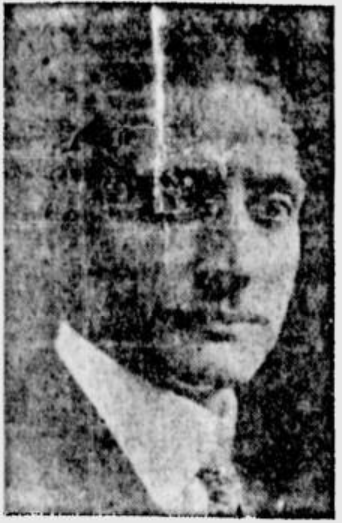
Rasso.
Rasso published a series of ten juggling lessons in various U.S. newspapers, explaining tricks designed for amateur jugglers.
After reviewing archival material from several newspapers, I was able to compile all ten of Rasso’s published lessons. In this article, we will look at the first two.
Easy juggling – Lesson 1
This first lesson was published in the Oakland Tribune on March 12, 1922.
Rasso, one of the most widely known of professional jugglers, has prepared a series of ten lessons in easy juggling especially for the Oakland Tribune. This is his first.
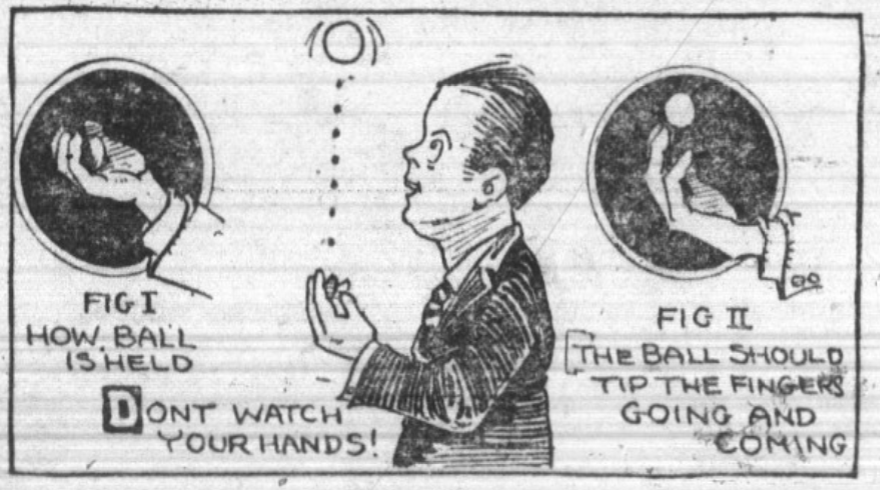
Figure 1: The single vertical throw
At the age of nine I had decided to become a juggler. Unfortunately, I chose our kitchen as the most desirable place in which to master the art.
It was but a few minutes after starting the first practice that a stray juggling ball crashed into my mother’s china set.
The next practice was held in our barn, far from anything breakable.
The first step I made as a beginning juggler was to acquire skill in the “single vertical throw.” done with one ball. It is a simple stunt, lacking the spectacular, but one that must be mastered.
Buy juggling balls
At a variety store you can purchase for about 10 cents a hard rubber ball, an inch and a half or two inches in diameter, similar to the ball used by professional jugglers. While you are about it, buy two more of these balls, to be used later on.
Grasp one ball loosely in one hand, holding it with the fingers near the top of the palm. Figure 1 (above) illustrates the hold. Then toss the ball up easily, allowing it to roll out of your hand over the fingers, which guide the ball in a straight upward path. Figure 2 shows the proper position of the hand as the ball leaves.
Catch the ball in the same hand. Do not catch it with a loud smack in the flat palm, for they all may bounce out. Allow it to tip the fingers first, and roll easily into the palm. The fingers naturally close over it and hold it there. Figure 2 also shows how the hand should be held when catching the ball.
At first do not throw the ball high. About a twelve-inch-toss is a good starter.
Practice the toss with both right and left hands until you can control the ball perfectly with both, tossing it up a straight line and having it fall in the same course. Get the toss so perfect that you do not have to shift hand forward or backward or sideways at all, or very little at the most.
Watch the ball and not your hand.
Swing arm freely
A free, easy swing of the arm is necessary in not only this vertical throw, but in all juggling tricks. If you hold your elbows stimy at your sides your movements will not be graceful,
In the next lessons I will tell how to juggle two balls in one hand, a neat accomplishment. It is not the purpose of these lessons to show you the way to professional juggling. but to show you how some of the simpler tricks are performed, so that you can do them and appreciate the tricks done by professionals Unless you are sure you have the talent as an actor, and talent as a juggler, I do not advise you to go in for professional juggling.
However, until the next work with the single vertical throw and train your eyes and hands to judge accurately where the ball is going when it leaves your hand.
Easy juggling – lesson 2
This second lesson was published in the *Long Beach Telegram* on November 29, 1921.
Double Vertical Throw
Well do I remember the day when I first succeeded in juggling two balls in one hand without dropping them. I was right proud of my ability.
Because I did not know how to hold two balls in one hand I had much trouble at first. Soon, however, I learned that the most convenient method of holding two balls is that illustrated in figure [above], which shows two views of the hand.
How Balls Are Held
One ball is held in the palm. The little and ring fingers hold it in place. The other ball is held in the fingers, in front of the first ball, and gripped by the index and middle fingers and the thumb.
This grip on the halls allows you to toss one up without dropping the other. The ball held in the fingers always is the one thrown up first. As I mentioned in the first lesson, the ball should roll over the tips of the fingers as it leaves your hand. The fingers guide it in its course. When the first ball has been thrown, the second ball rolls into the fingers, taking the place of the first.
Matter of Speed
This “double vertical throw” is easy if you have completely mastered the single verticle throw described in our first lesson. To be able to do it is merely a matter of increasing the speed of your hands.
Take the two balls in one band. If you are right handed start with that hand. Toss the first ball, A. (figure 2, above) about two feet into the air. The ball does not take a perfectly vertical course, but is thrown so that, as it turns to come down, its downward path is about two inches to the right side of its upward path.
As A ball turns to fall, toss up B ball. B takes A’s course, but because A takes a downward path to the side of its upward course, the two do not collide.
When B ball has reached the highest point, A ball is being caught. Throw A up again, making it take its original upward path. The two balls follow each other in sort of a wheel.
A Variation
There are variations of this double vertical throw. Figure 3 (above) illustrates one. Instead of the balls following each other, each has its own up and down course.
A ball, the first tossed up, takes an exact vertical course. When throwing up B, shift the hand slightly to one side. Thus, B takes a course of its own.
The hand must be shifted again to catch A ball. As soon as you receive it throw it up again so that your hand is free to catch B ball.

Easy juggling – las diez lecciones de Rasso
Por: Esteban Vélez.
Rasso fue un malabarista muy popular en Estados Unidos y en Europa. Realizó varias giras por diferentes ciudades de Estados Unidos, Italia, Francia, Alemania, entre otros países.
Nació en una familia de artistas: su padre fue un malabarista reconocido integrante del grupo “Rasso Trío”; su madre fue una cantante de ópera. Inspirado por su padre, aprendió a hacer malabares con diferentes objetos.
En una entrevista para el diario The Herald, en 1922, Rasso contó algunos aspectos de su vida:
“Nací en Alsacia-Lorena; concretamente, en Estrasburgo. Años más tarde, mi madre —una conocida cantante de ópera— me llevó a Italia para estudiar canto con el célebre maestro Ugulini. Hasta los nueve años asistí a la escuela del convento inglés, donde aprendí inglés y francés. Por aquel entonces, siempre intentaba imitar a mi padre: hacía malabares con piedras de la Roma antigua en las mazmorras subterráneas del Coliseo.
Luego, me enviaron de vuelta a Estrasburgo para continuar mis estudios. Allí recibí mis primeras lecciones de malabarismo de manos de mi padre. A los diecisiete años dejé la escuela, habiendo aprendido a hacer malabares con todos los objetos sueltos de la institución, incluidos mis libros”.
Rasso.
Rasso publicó en varios periódicos de Estados Unidos una serie de diez lecciones de malabarismo. Allí, explicó algunos trucos para malabaristas aficionados.
Luego de una revisión de material de archivo en varios periódicos pude recopilar las 10 publicaciones de Rasso. En este artículo veremos las dos primeras lecciones.
Easy Juggling – lección 1
Esta primera lección fue publicada en el diario Oakland Tribune el 12 de marzo de 1922.
Rasso, uno de los malabaristas profesionales más conocidos, ha preparado una serie de diez lecciones de malabarismo sencillo especialmente para el *Oakland Tribune*. Esta es la primera.
El lanzamiento vertical simple
A los nueve años decidí convertirme en malabarista. Por desgracia, elegí nuestra cocina como el lugar ideal para dominar la técnica.
Apenas habían pasado unos minutos desde que comencé la primera práctica cuando una pelota de malabares se estrelló contra la vajilla de porcelana de mi madre.
La siguiente práctica tuvo lugar en nuestro granero, lejos de cualquier objeto frágil.
El primer paso que di como malabarista principiante fue adquirir destreza en el “lanzamiento vertical simple”, realizado con una sola pelota. Es una maniobra sencilla, sin pretensiones de espectacularidad, pero que es necesario dominar.
Compra de pelotas de malabares
En una tienda de artículos variados puedes comprar, por unos 10 centavos, una pelota de goma dura de una pulgada y media o dos pulgadas de diámetro, similar a la que usan los malabaristas profesionales. Aprovecha para comprar otras dos pelotas iguales, ya que las necesitarás más adelante.
Sujeta una pelota sin apretar con una mano, manteniéndola con los dedos cerca de la parte superior de la palma. La Figura 1 ilustra cómo sostenerla. Luego, lanza la pelota hacia arriba con suavidad, dejando que ruede fuera de la mano pasando por los dedos, los cuales guían la trayectoria de la pelota en línea recta ascendente. La Figura 2 muestra la posición correcta de la mano en el momento en que la pelota la abandona.
Atrapa la pelota con la misma mano. No la atrapes provocando un golpe seco y ruidoso en la palma abierta, ya que de lo contrario podrían rebotar y salirse. Deja que la pelota toque primero las yemas de los dedos y ruede suavemente hacia la palma; los dedos se cerrarán de forma natural sobre ella para sujetarla. La Figura 2 también muestra cómo debe colocarse la mano al atrapar la pelota.
Al principio, no lances la pelota muy alto; un lanzamiento de unos 30 centímetros (doce pulgadas) es un buen punto de partida.
Practica el lanzamiento tanto con la mano derecha como con la izquierda hasta que puedas controlar la pelota perfectamente con ambas, lanzándola en línea recta y logrando que caiga siguiendo la misma trayectoria. Perfecciona el lanzamiento de modo que no tengas que mover la mano hacia adelante, hacia atrás o hacia los lados, o que el movimiento sea mínimo.
Observa la pelota, no tu mano.
Balancea el brazo con libertad
Un movimiento libre y fluido del brazo es esencial no solo para este lanzamiento vertical, sino para todos los trucos de malabarismo. Si mantienes los codos rígidos pegados al cuerpo, tus movimientos carecerán de gracia.
En las próximas lecciones explicaré cómo hacer malabares con dos pelotas en una sola mano, una habilidad muy vistosa. El objetivo de estas lecciones no es convertirte en un malabarista profesional, sino enseñarte a realizar algunos de los trucos más sencillos para que puedas hacerlos y apreciar las actuaciones de los profesionales. A menos que estés seguro de poseer talento tanto para la actuación como para el malabarismo, no te aconsejo dedicarte profesionalmente a ello. No obstante, hasta la próxima lección, sigue practicando el lanzamiento vertical simple y entrena tus ojos y manos para calcular con precisión la trayectoria de la pelota al salir de tu mano.
Easy juggling – lección 2
Esta segunda lección fue publicada en Long Beach Telegram el 29 de noviembre de 1921.
Lanzamiento vertical doble
Recuerdo muy bien el día en que logré por primera vez hacer malabarismo con dos pelotas en una sola mano sin que se me cayeran. Estaba muy orgulloso de mi habilidad.
Al principio tuve muchas dificultades porque no sabía cómo sostener dos pelotas en una mano. Sin embargo, pronto aprendí que la forma más práctica de sujetarlas es la que se ilustra en la figura 1, donde se muestran dos vistas de la mano.
Cómo se sostienen las pelotas
Una pelota se coloca en la palma de la mano y se mantiene en su sitio con los dedos meñique y anular.
La otra pelota se sostiene con los dedos, delante de la primera, sujetándola entre los dedos índice y medio y el pulgar.
Esta forma de sujetar las pelotas permite lanzar una hacia arriba sin que se caiga la otra. La pelota que se sostiene con los dedos es siempre la que se lanza primero. Como mencioné en la primera lección, la pelota debe rodar sobre las yemas de los dedos al salir de la mano; los dedos guían su trayectoria. Una vez lanzada la primera pelota, la segunda rueda hacia los dedos, ocupando el lugar de la primera.
Cuestión de velocidad
Este “lanzamiento vertical doble” resulta sencillo si ya dominas por completo el lanzamiento vertical simple descrito en nuestra primera lección. Lograrlo es simplemente cuestión de aumentar la velocidad de las manos.
Toma las dos pelotas en una mano. Si eres diestro, empieza con esa mano. Lanza la primera pelota, la A (figura 2), a unos sesenta centímetros (dos pies) de altura. La pelota no sigue una trayectoria perfectamente vertical; se lanza de modo que, al cambiar de sentido para bajar, su recorrido descendente queda unos cinco centímetros (dos pulgadas) a la derecha de su recorrido ascendente.
Justo cuando la pelota A empieza a caer, lanza la pelota B. La pelota B sigue la misma trayectoria que la A, pero como la A desciende por un lado distinto al de su ascenso, ambas no chocan.
Cuando la pelota B alcanza su punto más alto, la pelota A está siendo atrapada. Lanza de nuevo la A, haciendo que siga su trayectoria ascendente original. Las dos pelotas se suceden en un movimiento similar al de una rueda. Una variante
Existen variantes de este lanzamiento vertical doble. La figura 3 ilustra una de ellas. En lugar de que las pelotas se sigan una a la otra, cada una describe su propia trayectoria de ascenso y descenso.
La primera pelota lanzada hacia arriba sigue una trayectoria estrictamente vertical. Al lanzar la pelota B, desplace ligeramente la mano hacia un lado; de este modo, la pelota B seguirá su propia trayectoria.
Deberá desplazar la mano nuevamente para atrapar la pelota A. Tan pronto como la reciba, vuelva a lanzarla hacia arriba para liberar la mano y así poder atrapar la pelota B.
Esteban Velez

Soy un malabarista deportivo. Tengo la maravillosa oportunidad de escribir para eJuggle. Me gusta la historia, la historia militar, la filosofía, la poesía, las historias raras, y las historias de terror y de horror.