
By: Esteban Vélez.
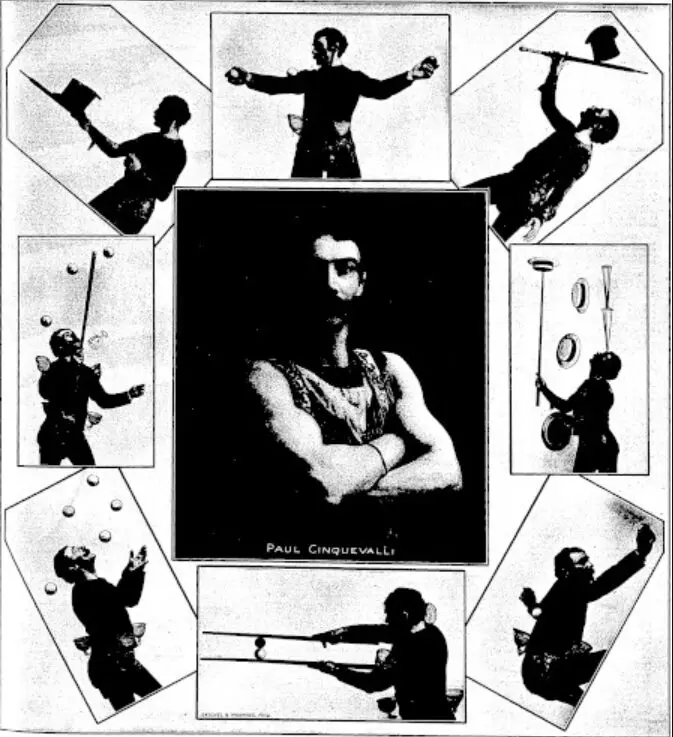
Paul Cinquevalli is considered one of the greatest jugglers in history. His name is alongside Enrico Rastelli, Salerno, Kara, and many other classic jugglers. Most of his feats have not been replicated due to their difficulty and experimental nature.

His real name was Emile Otto Lehmann-Braun. He was born on June 30, 1859, in the province of Posen, in what is now Poland. His career began in gymnastics at the age of 14 when he ran away from home to join the acrobatic company of the Italian Giuseppe Chiese-Cinquevalli. After a fall from the trapeze that led him to abandon acrobatics, Paul decided to become a juggler.
The Juggling Hall of Fame website wrote about Paul Cinquevalli:
“Most of his tricks were his own invention and included manipulating billiard balls and cues, hats, umbrellas, steel balls, suitcases, chairs—anything that wasn’t nailed down. In one of his most famous routines, he juggled and rolled billiard balls on his green felt jacket, catching the balls in various pockets on his body. In a burst of linguistic dexterity, the press seized the opportunity to dub him “The Human Billiard Table.” His style and appearance may seem old-fashioned today, but in retrospect, one realizes that he did a great job of modernizing the public perception of juggling.”


Cinquevalli performed for the King and Queen of England, the Prince of Wales, and other monarchs.
Sadly, during World War I, Paul was shunned by the public that had so admired him because of his German heritage. He died in Brixton, London, on July 14, 1918.
If you want to know more about Paul Cinquevalli, you can consult here, here, and here. You can also purchase the book Cleverer Than God by juggling historian Erik Aberg about Paul Cinquevalli’s life.
Cinquevalli wrote several articles that were published in different newspapers in the countries he visited on his tours. Thanks to these writings, we can learn about aspects of his life.

This time we will see an article by Cinquevalli where he narrates a personal experience with juggling. It was published in the North Otago Times on November 13, 1909.
“Once a juggler always a juggler”
He takes no holidays
The one great drawback to a juggler’s career is that he can never take a holiday a complete holiday that is, not even for a day. Every day of my life I have to keep juggling three billiard balls in one hand, and when I go out for a walk in the country, I take five tennis balls in my pocket and juggle them as I walk along the road.
Once I took a complete holiday for a week, during which time I never practiced any feat. At the end of the week. I was due to appear and went straight to the theatre in the evening without any practice before hand. It was just as well I did so, or I probably should have been afraid to keep my engagement, for I found, to my horror, when I began to perform even the simplest feats bad deserted me, though I don’t think the audience noticed this. I was all right again in a few days, but I resolved never again to take a holiday during my professional career.
I have seen many queer things during my travels, and have juggled all over the world before all sorts and conditions of audiences. The life of a juggler, as I can testify, is Sinecure indeed, hard work, constant practice, and ingenuity in devising new teats are indispensable to success
“Once a juggler always a juggler.” -Paul Cinquevalli, in the “Royal Magazine.”
Una vez malabarista, siempre malabarista
Por: Esteban Vélez.
Paul Cinquevalli es considerado como uno de los mejores malabaristas de la historia. Su nombre está al lado de Enrico Rastelli, Salerno, Kara, y muchos otros malabaristas clásicos. La mayoría de sus logros no han sido replicados debido a su dificultad y experimentación.
Su verdadero nombre era Emile Otto Lehmann-Braun. Nació el 30 de junio de 1859, en la provincia de Posen, actual Polonia. Su carrera inició en la gimnasia a la edad de 14 años cuando se escapó de su casa para unirse a la compañía acrobática del italiano Giuseppe Chiese-Cinquevalli. Luego de una caída del trapecio que lo alejó de las acrobacias, Paul decidió convertirse en malabarista.
La página Juggling Hall of Fame escribió acerca de Paul Cinquevalli:
“La mayoría de sus trucos eran de su propia invención e incluían la manipulación de bolas y tacos de billar, sombreros, paraguas, bolas de acero, maletas, sillas, cualquier cosa que no estuviera clavada. En una de sus rutinas más famosas, hacía malabares y hacía rodar bolas de billar sobre su chaqueta de fieltro verde, atrapando las bolas en varios bolsillos de su cuerpo. En un arrebato de destreza lingüística, la prensa aprovechó la ocasión para otorgarle el título de “La mesa de billar humana”. Su estilo y apariencia pueden parecer anticuados hoy en día, pero cuando se mira en perspectiva, uno se da cuenta de que hizo un gran trabajo para modernizar la concepción pública de los malabares”.

Cinquevalli actuó para el rey y la reina de Inglaterra, para el príncipe de Gales, entre otros monarcas.
Lastimosamente, durante la Primera guerra mundial, Paul fue rechazado por el público que tanto lo admiraba debido a su herencia alemana. Murió en Brixton, Londres, el 14 de julio de 1918.
Si quieres saber más sobre Paul Cinquevalli puedes consultar aquí, aquí y aquí. Además, puedes adquirir el libro Cleverer Than God del historiador de malabarismo Erik Aberg acerca de la vida de Paul Cinquevalli.
Cinquevalli escribió varios artículos que fueron publicados en diferentes periódicos de países que visitaba en sus giras. Gracias a esos escritos podemos conocer aspectos de su vida.
En esta ocasión veremos un artículo de Cinquevalli donde narra una experiencia personal con el malabarismo. Fue publicado en el diario North Otago Times, el 13 de noviembre de 1909.
“Una vez malabarista, siempre malabarista”
No se toma vacaciones
El gran inconveniente de la carrera de malabarista es que nunca puede tomarse unas vacaciones, unas vacaciones completas, ni siquiera un día. Todos los días de mi vida tengo que hacer malabares con tres bolas de billar en una mano, y cuando salgo a caminar por el campo, llevo cinco pelotas de tenis en el bolsillo y hago malabares con ellas mientras camino por la carretera.
Una vez me tomé unas vacaciones completas de una semana, durante la cual no practiqué ningún truco. Al final de la semana, tenía que actuar y fui directamente al teatro por la noche sin haber practicado nada antes. Menos mal que lo hice, o probablemente debería haber tenido miedo de cumplir con mi compromiso, porque descubrí, para mi horror, que cuando empecé a realizar incluso los trucos más sencillos, me quedé sin fuerzas, aunque creo que el público no se dio cuenta. Me recuperé en pocos días, pero decidí no volver a tomarme vacaciones durante mi carrera profesional.
He visto muchas cosas extrañas durante mis viajes y he hecho malabares por todo el mundo ante todo tipo de público. La vida de un malabarista, como puedo atestiguar, es sinecura; el trabajo duro, la práctica constante y el ingenio para idear nuevos trucos son indispensables para el éxito.
Una vez malabarista, siempre malabarista. -Paul Cinquevalli, en la “Royal Magazine”.
Esteban Velez

Soy un malabarista deportivo. Tengo la maravillosa oportunidad de escribir para eJuggle. Me gusta la historia, la historia militar, la filosofía, la poesía, las historias raras, y las historias de terror y de horror.